Source: Special-Education-Degree.net
The 5 ‘W’s of special ed
Or, why special needs treatment is a right.Who?
People…
Of households with children
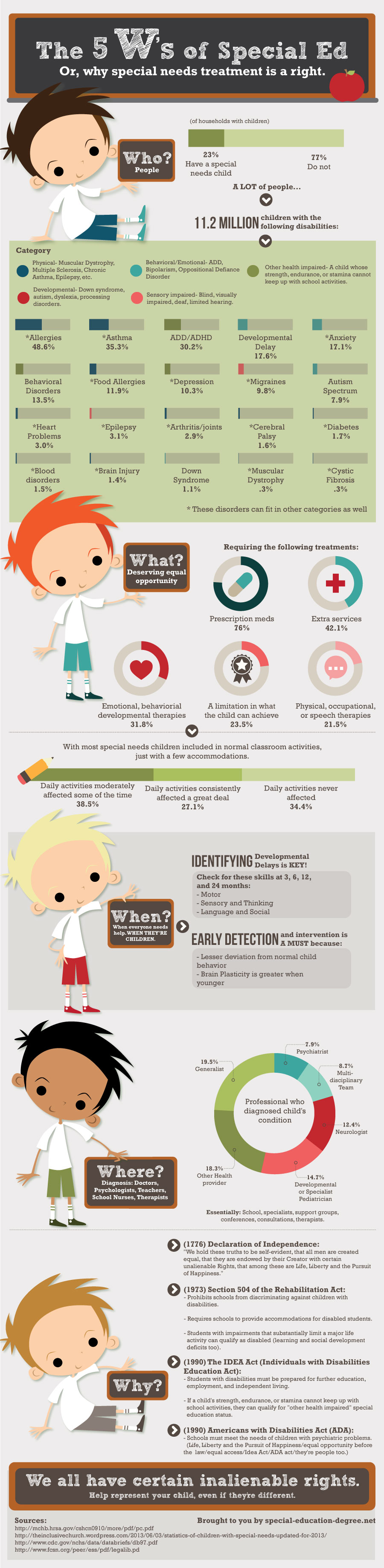
23% Have a special needs child
77% do not.[1]
Make that a lot of people…
That’s 11.2 million children with the following disabilities:[1]
In the Following Categories:
1.) Physical– Muscular Dystrophy, Multiple Sclerosis, Chronic Asthma, Epilepsy, etc.
2.) Developmental–Down syndrome, Autism, Dyslexia, Processing Disorders.
3.) Behavioral/Emotional–ADD, Bipolarism, Oppositional Defiance Disorder
4.) Sensory impaired–Blind, Visually Impaired, Deaf, Limited Hearing.
5.) Other health impaired–A child whose strength, endurance, or stamina cannot keep up with school activities.
What?
Deserving equal opportunity
Requiring the following treatments:[1]
76% Prescription Meds
42.1% Extra Services
31.8% Emotional, Behavioral, Developmental therapies
23.5% A limitation in what the child can achieve
21.5% Physical, Occupational, or Speech therapies
With most special needs children included in normal classroom activities, just with a few accommodations.
38.5% Daily activities moderately affected some of the time[1]
27.1%Daily Activities consistently affected a great deal
34.4% Daily Activities never affected
When?
When everyone needs help. WHEN THEY’RE CHILDREN.
Identifying Developmental Delays is KEY:
Check for:
Motor skills
Sensory and Thinking Skills
Language and Social Skills
At 3,6,12,and 24 months
Early detection and intervention is A MUST because:
Lesser deviation from normal child behavior
Brain Plasticity is greater when younger
Where?
Diagnosis: Doctors, Psychologists, Teachers, School Nurses, Therapists
[% health providers who notified parents as to their child's condition]
7.9% Psychiatrist
8.7% Multidisciplinary Team
12.4% Neurologist
14.7% Developmental or Specialist Pediatrician
18.3% Other Health provider
18.5% Psychologist/school psychologist
19.5% Generalist
Essentially: School, specialists, support groups, conferences, consultations, therapists.
Why?
1.) (1776)Declaration of Independence: “We hold these truths to be self-evident, that all men are created equal, that they are endowed by their Creator with certain unalienable Rights, that among these are Life, Liberty and the pursuit of Happiness.”
2.) (1973)Section 504 of the Rehabilitation Act:
–Prohibits schools from discriminating against children with disabilities.
–Requires schools to provide accommodations for disabled students.
–Students with impairments that substantially limit a major life activity can qualify as disabled (learning and social development deficits too).
3.) (1990)The IDEA Act (Individuals with Disabilities Education Act):
–Students with disabilities must be prepared for further education, employment, and independent living.
–If a child’s strength, endurance, or stamina cannot keep up with school activities, they can qualify for “other health impaired” special education status.
4.) (1990)Americans with Disabilities Act(ADA):
–Schools must meet the needs of children with psychiatric problems.

