By Jennifer Senior
Thousands of books have examined the effects of parents on their
children. In All Joy and No Fun, award-winning journalist Jennifer
Senior now asks: what are the effects of children on their parents?
In All Joy and No Fun,
award-winning journalist Jennifer Senior tries to tackle this question,
isolating and analyzing the many ways in which children reshape their
parents' lives, whether it's their marriages, their jobs, their habits,
their hobbies, their friendships, or their internal senses of self. She
argues that changes in the last half century have radically altered the
roles of today's mothers and fathers, making their mandates at once more
complex and far less clear.
Recruiting from a wide variety of
sources—in history, sociology, economics, psychology, philosophy, and
anthropology—she dissects both the timeless strains of parenting and the
ones that are brand new, and then brings her research to life in the
homes of ordinary parents around the country. The result is an
unforgettable series of family portraits, starting with parents of young
children and progressing to parents of teens. Through lively and
accessible storytelling, Senior follows these mothers and fathers as
they wrestle with some of parenthood's deepest vexations—and luxuriate
in some of its finest rewards.
Meticulously researched yet imbued with emotional intelligence, All Joy and No Fun
makes us reconsider some of our culture's most basic beliefs about
parenthood, all while illuminating the profound ways children deepen and
add purpose to our lives. By focusing on parenthood, rather than parenting, the book is original and essential reading for mothers and fathers of today—and tomorrow.
Order today on Amazon!
Parenting Books, Magazines and Websites to help parents with children, tweens, and teens. Some of these are not official book reviews, they are for informational purposes. Parent's Universal Resource Experts (P.U.R.E.)
Showing posts with label Entitlement Issues. Show all posts
Monday, January 13, 2014
Thursday, September 9, 2010
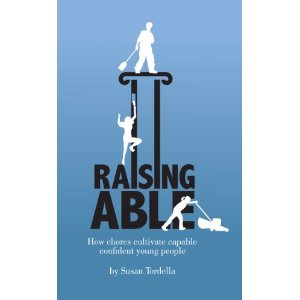
Raising Able by Susan Tordella
Raising Able describes how to enlist 2-to-22-year olds in contributing around the house.
Young people will feel a sense of belonging, while learning responsibility and self-discipline. Chores nurture self-esteem and develop competence while giving the adults a break from being the family servants.
Cleaning toilets, doing dishes and sweeping the floor counteract entitlement. Learn more positive parenting strategies to have a calmer, more harmonious home, written by a mother of four who has coached other parents in workshops for nearly a decade.
Learn more about the author and the book.
Young people will feel a sense of belonging, while learning responsibility and self-discipline. Chores nurture self-esteem and develop competence while giving the adults a break from being the family servants.
Cleaning toilets, doing dishes and sweeping the floor counteract entitlement. Learn more positive parenting strategies to have a calmer, more harmonious home, written by a mother of four who has coached other parents in workshops for nearly a decade.
Learn more about the author and the book.
Tuesday, October 20, 2009
Sue Scheff: Generation Me: Why Today's Young Americans Are More Confident, Assertive, Entitled--and More Miserable Than Ever Before
Generation Me: Why Today's Young Americans Are More Confident, Assertive, Entitled--and More Miserable Than Ever Before
By: Jean M. Twenge, Ph.D.
Who is part of Generation Me?
Generation Me describes anyone born in the 1970s, 1980s, or 1990s -- in 2006, this means people between the ages of 7 and 36. These are today's young people, those who take it for granted that the self comes first. I'm a member of this generation myself, born in 1971.
How is Generation Me different from previous generations, especially from the "Me generation" of the 1970s?
Baby Boomers were sometimes called the "Me generation" in the 1970s, but this was a premature and brief label: Boomers did not discover the self until young adulthood, and even then did everything in groups, from protests to seminars like est. Generation Me has never known a world that put duty before self, and believes that the needs of the individual should come first. This is not the same thing as being selfish – it is captured, instead, in the phrases we so often hear: "Be yourself," "Believe in yourself," "You must love yourself before you can love someone else." These are some of our culture's most deeply entrenched beliefs, and Generation Me has grown up hearing them whispered in our ears like the subliminally conditioned children in Aldous Huxley's Brave New World.
How is this book different from other books on generations?
In short, because it has hard data on how the generations really differ. Most books on generations throw around ideas about social trends and pop culture, but don't have much data on the actual characteristics of people from different generations. This book has the data -- it summarizes thirteen years of my research on the responses of 1.3 million young people. I found research reports on children and college students who completed questionnaires measuring everything from anxiety to sexual behavior. Many of these questionnaires have been used since the 1950s or 1960s, allowing me to see how today's young people differ from Baby Boomers and previous generations. Every chapter is built around a research result, with lots of pop culture analysis and examples to bring the differences to life. To find out more about how I collected this data, click here.
What is the book about?
We live in a time when high self-esteem is encouraged from childhood, when young people have more freedom and independence than ever, but also far more depression, anxiety, cynicism, and loneliness. Today's young people have been raised to aim for the stars at a time when it is more difficult than ever to get into college, find a good job, and afford a house. Their expectations are very high just as the world is becoming more competitive, so there's a huge clash between their expectations and reality. More than any other generation in history, the children of Baby Boomers are disappointed by what they find when they arrive at adulthood. Generation Me will give Boomers new insight into their offspring, and help those in their teens, twenties, and thirties finally make sense of their generation.
I was born after 1981. What is my generation called?
No one knows yet. The previous generation (born 1961-1981) is usually called "Generation X," and this label is well-established. The post-1981 generation has been called "Gen Y," but give me a break – who wants to be named after the people older than you? "Baby Busters," an early label for GenX, never caught on for that reason. Writers William Strauss and Neil Howe use the label "Millennials" for post-1981 people, but that seems kind of out now that we're not worrying about Y2K. Generation Me could become the label, though it's meant more as a description.
I propose that the 1981-1999 generation be called iGeneration, or iGen. This generation has been profoundly shaped by technology, including the Internet (which is what the "i" stands for in "iMac") and of course iPods. The "i" also captures the essence of my description of Generation Me: it can stand for the first person singular or be "i" for individual. You heard it here first.
Order today on Amazon!
Friday, October 16, 2009
Sue Scheff: The Entitlement-Free Child

Raising confident and responsible kids in a "me, mine, now!" culture
In a world of quick fixes and instant gratification, The Entitlement-Free Child is your essential resource for how and when to say no, how and when to praise, how to handle age-appropriate challenges, and how to set reasonable expectations—all while maintaining unconditional love.
Expert advice for the newest and most in-demand parenting hot-button issue. Parenting expert Karen Deerwester offers hundreds of practical strategies and hands-on tips to guide you through today's confusing parenting situations at home and in public, including:
Cell phones
Eating out
Birthday parties
Bossiness
Teacher conflicts
Allowances
Bickering siblings
Dinnertime demands
Put an end to the stubbornness, disrespect, and social problems now by giving your child the resourcefulness to get what she needs and the confidence to respect the needs of others. The Entitlement-Free Child is the new essential resource for 21st-century parenting. Unlock your child's potential today!
Order on Amazon today!
Thursday, July 9, 2009
Sue Scheff: Don't Give Me That Attitude

By Michele Borba
Does your kid never take no for an answer and demand things go his way?
Do her theatrics leave you drained at the end of the day?
Are you resorting to bribes and threats to get your kid to do chores?
Does he cheat, complain, or blame others for his problems?
Do you feel you’re running a hotel instead of a home?
Are you starting to feel like your child’s personal ATM machine?
What happened? You thought you were doing the best for your child and didn’t set out to raise a selfish, insensitive, spoiled kid. In one of her great parenting books, Don’t Give Me That Attitude! parenting expert Michele Borba offers you an effective, practical, and hands-on approach to help you work with your child to fix that very annoying but widespread youthful characteristic, attitude. If you have a child who is arrogant, bad-mannered, bad-tempered, a cheat, cruel, demanding, domineering, fresh, greedy, impatient, insensitive, irresponsible, jealous, judgmental, lazy, manipulative, narrow-minded, noncompliant, pessimistic, a poor loser, selfish, uncooperative, ungrateful, or unhelpful, this is the book for you!
Learn more and order today from Amazon! Type the title in the Amazon box on the sidebar.
Tuesday, April 21, 2009
Sue Scheff: Teen Entitlement Issues - The Narcissism Epidemic

In their new book, “The Narcissism Epidemic,” psychologists Jean M. Twenge and W. Keith Campbell explore the rise of narcissism in American culture and explain how this can lead to aggression, materialism and shallow values.
Introduction
We didn't have to look very hard to find it. It was everywhere.
On a reality TV show, a girl planning her sixteenth birthday party wants a major road blocked off so a marching band can precede her grand entrance on a red carpet. A book called “My Beautiful Mommy” explains plastic surgery to young children whose mothers are going under the knife for the trendy “Mommy Makeover.” It is now possible to hire fake paparazzi to follow you around snapping your photograph when you go out at night — you can even take home a faux celebrity magazine cover featuring the pictures.
Read more: http://today.msnbc.msn.com/id/30312181/
Subscribe to:
Posts (Atom)