Parenting Books, Magazines and Websites to help parents with children, tweens, and teens. Some of these are not official book reviews, they are for informational purposes.
Parent's Universal Resource Experts (P.U.R.E.)
Every month parents and children should be implementing their online safety skills, however we recognize that June is the month that we should take extra time to learn more about what's going on with your child's digital lives by going dark!
That's it! Go Dark for Dinner is the campaign for June - it's all about unplugging and actually communicating. Offline parenting is key to online safety. It's key for your child making better online choices they are faced with daily; especially in times when you can't be there.
Think about Internet Safety Month as a time to disconnect and connect at the dinner table. Chat about your digital lives and your offline lives. Get to know each other -- in real life!
Most people, especially parents and teens, will be oversharing their summer experiences on social media.
We have become almost immune to people telling us what they are eating or even when they decide to go to the park. Things we used to do without broadcasting to the world wide web. Sure, we assume our privacy controls and filters are all in place - but are they truly working the way we believe they are?
Hopefully they are, but how many times have people been caught with their hand in the cookie jar (hypothetically speaking) or literally with their pants down?
We all need to be aware that your digital image today is usually the first impression people will have of you. You never get a second chance to make a first impression.
Learn more about GeckoLife - an opportunity to share safely and privately.
With 92% of middle and high school students online daily, 24% of them "almost constantly,"* it's time schools had some help with social media! The Helpline's developers – #iCANHELP and Net Family News Inc. – invite you to contribute to a fundraising campaign at Indiegogo.com: http://igg.me/at/icanhelpline. The goal of the campaign is $25,000 to cover "construction costs" for piloting in California next school year – Web site construction, communications tools and staff training.
"The helpline will be the hub of a whole help ecosystem," said Matt Soeth, co-founder of #iCANHELP, "with real-time, research-based advice, help in reporting and escalating abuse in social media services, a directory of school policy and investigation resources and a growing, searchable database of school social media case studies."
"Contributions big or small are huge to the helpline," said Anne Collier, president of San Jose-based Net Family News. "This is about growing the digital literacy and citizenship of all members of school communities.”
Here's what we're talking about:
A call center-plus: Schools can call during school hours for real-time help, but the Web site – which will include links to sources of specialized help and a directory of resources for prevention, incident response and policymaking – is 24/7/365. To be added as cases come in: an ever-growing searchable database of anonymized school case studies. The Helpline will also be a source of metrics & trends in school online safety issues for educators, researchers, policymakers and parents.
Schools not individuals – We'll refer individuals to other great sources of help, but this helpline's specifically for schools. If a member of a school community has a problem, we'll ask him or her to work with us through their school.
Working with social media: We'll help schools navigate sites and apps, report abuse and get content taken down that violates Terms of Service, providing the industry with much-needed local context as a trusted intermediary.
Part of a global network of helplines in other countries that help each other and, with a growing collective knowledge base, help users resolve problems in a global medium.
Unique among helplines in approaching students as part of the solution and building on established student leadership education and peer-mentoring practices.
Deep Internet safety experience: Builds on more than 15 years in the Internet safety space, working with practitioners and researchers and advising Internet companies.
About us: Net Family News is a San Jose, Calif.-based national nonprofit organization founded in 1999 to educate the public and advise the Internet industry about research and developments in technology related to youth. #iCANHELP is a Bay Area-based national nonprofit organization that creates and promotes positive, school-based solutions & interventions to anti-social behavior online.
Frienedy is the first site of its kind that lets users of all ages manage life in groups. Engineered with parental permissions at the core, the company has created a private online environment that leverages parental engagement for users under 13 to guide the social media experience. Frienedy offers users of all ages a web application that provides private group communication.
Until now, there has been a void in the social networking space both for users under age 13 as well as for managing content and social feeds for groups of all types.
According to Founder and CEO, Janel Patterson, "Kids are getting online much younger than they were when today's social networking norms were first established, which has led to a rise in cyber bullying and cyber predators. Parents need a tool that enables them to proactively introduce social media to their children when they decide the time is right- and before kids go out and discover it themselves. At Frienedy, our core mission is to prevent cyber bullying before it starts and to eliminate the risk of children becoming victims of cyber predators."
There is also a market for managing social feeds and content for groups that have members of all ages. According to Jake Giganti, COO for Frienedy, "I grew up on social media. I never saw an easy way to manage all of the events and social feeds and basic information for every group I was part of growing up. Not just my soccer team and classes, but my different groups of friends. And, now as an adult, I have even more social groups I'm part of and need to stay engaged with. Frienedy Groups solves this problem- but more compellingly- for users of all ages." Groups can communicate privately and maintain practice or meeting schedules, classroom assignments, youth group activities, photos, videos, documents, even trigger last minute notifications. Frienedy is the way to manage all of this - and for younger users, under discreet parental oversight.
Frienedy includes a robust events calendar for managing group events and a shopping list feature called WishList to promote user engagement. Mobile apps are currently in development, and the website is currently mobile responsive for any device. You can sign up for a free account by going to www.frienedy.com.
About Frienedy Frienedy, LLC (www.frienedy.com) was founded in 2013 as a safe, private group networking community designed for users and groups of all ages. Frienedy complies with COPPA standards for users under 13, enabling a revolutionary new way for people of all ages to connect, share and interact safely and privately in all of life's Groups.
Congratulations to our three Pause & Think Online Video Contest winners!
Common Sense Media was impressed with the creativity, the musicality, and the artistry exhibited in all three. Thank you to all of the students and teachers who submitted videos. See all of the contest submissions here.
ThirdParent pride themselves on giving parents access to the essential
information they need to protect a teen or preteen’s online reputation
and ensure their safe and responsible internet behavior.
In the interest
of online reputation management, our goal is to identify any negative
information that could be found in the course of searching for an
individual. They will alert you as to whether your child’s online
profiles, activity and privacy settings make them overly susceptible to
predators.
They scour every major search engine and every popular social
network to identify:
What is new about how teenagers communicate through services such as
Facebook, Twitter, and Instagram? Do social media affect the quality of
teens’ lives? In this eye-opening book, youth culture and technology
expert danah boyd uncovers some of the major myths regarding teens' use
of social media. She explores tropes about identity, privacy, safety,
danger, and bullying. Ultimately, boyd argues that society fails young
people when paternalism and protectionism hinder teenagers’ ability to
become informed, thoughtful, and engaged citizens through their online
interactions. Yet despite an environment of rampant fear-mongering, boyd
finds that teens often find ways to engage and to develop a sense of
identity.
Boyd’s conclusions are essential reading not only for
parents, teachers, and others who work with teens but also for anyone
interested in the impact of emerging technologies on society, culture,
and commerce in years to come. Offering insights gleaned from more than a
decade of original fieldwork interviewing teenagers across the United
States, boyd concludes reassuringly that the kids are all right. At the
same time, she acknowledges that coming to terms with life in a
networked era is not easy or obvious. In a technologically mediated
world, life is bound to be complicated.
Digital data collection and surveillance gets more pervasive
and invasive by the day; but the best ways to protect yourself and your
data are all steps you can take yourself. Digital devices make our
lives easier, with just-in-time coupons, directions, and connection with
loved ones while stuck on an airplane runway. Yet, these devices,
though we love them, invade our privacy in ways we might not even be
aware of. Our devices send and collect data about us whenever we use
them, but that data is not safeguarded the way we assume it would be. Privacy
is complex and personal. Many of us do not know the full extent to
which data is collected, stored, aggregated, and used. As recent
revelations indicate, we are subject to a level of data collection and
surveillance never before imaginable. While some of these methods may,
in fact, protect us and provide us with information and services we deem
to be helpful and desired, others can turn out to be insidious and
over-arching. Privacy in the Age of Big Data
highlights the many positive outcomes of digital surveillance and data
collection while also outlining those forms of data collection to which
we may not consent, and of which we are likely unaware. Payton and
Claypoole skillfully introduce readers to the many ways we are
‘watched,’ and how to adjust our behaviors and activities to recapture
our privacy. The authors suggest the tools, behavior changes, and
political actions we can take to regain data and identity security.
Anyone who uses digital devices will want to read this book for its
clear and no-nonsense approach to the world of big data and what it
means for all of us.
Stories about young people doing good things online rarely make headlines.
So, to showcase some of that good, a Platform for Good an infographic highlighting the amazing ways Millennials are using technology to make a difference.
Christian is the Project Assistant at the Family Online Safety Institute. As a believer in technology as a tool for positive change, he hopes to empower parents, teachers, and teens with the resources they need to responsibly navigate the digital world and make a difference.
Do
you want to know what kids are really doing online? Then you need to watch this
video. Then you need to check out this website: www.cyberwise.org.
CyberWise is dedicated to providing state-of-the-art
resources for BUSY grownups who want to understand how to use digital media
confidently and safely.
St. Augustine,
Fla.— St. Johns County is privileged to be featuring experts speaking on
topics that empower us to keep our kids safe through the Community Empowerment
Series. The final of three free sessions will be held on Saturday, April 27th
in the auditorium at Nease High School, and features nationally known internet
security expert Theresa Payton.
Payton
will talk about Internet Safety. This includes topics such as cyber-bullying,
children’s identity theft, technology’s role in kids’ lives and sexting. This
final session of the Community Empowerment Series is especially crucial due to
its effect on all ages.~ No one is immune to cyber-crimes and identity theft.
This
is a free event, however interested attendees are strongly encouraged to
register online to reserve a seat. Parents, students of all ages, grandparents,
school counselors, educators and anyone who wants to make our community a safer
place for kids will benefit from attending the series. For more online registration, sponsorship
opportunities and more information visit www.communityempowermentseries.com. A special thanks to The St. Augustine Record
and First Coast News WTLV for sponsoring this series.
Every parent worries about their children both online and off.
Who are they talking to online? Are they chatting with strangers?
What information are they sharing? Does your teen or child know the
boundaries?
Let’s face it, you can never be safe enough or secure enough–there is always something new to learn!
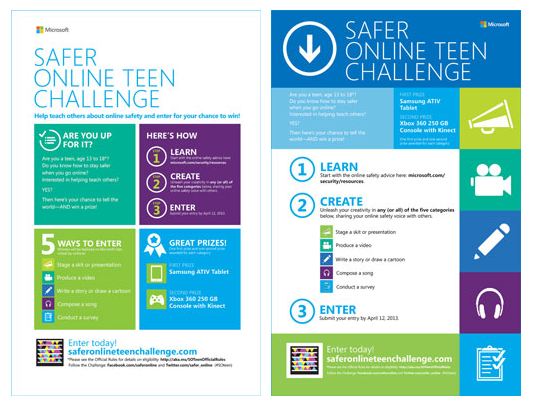
Encourage your teens to participate in The Safer Online Teen Challenge by Microsoft!
The Challenge is an interactive contest where teens can teach others
how to manage their digital lifestyle by creating a song, video, skit or
other original work. It’s a perfect way for teens to put their own spin
on how they navigate digital safety.
Here’s how it works:
• Teens ages 13 to 18 (where applicable), select an online safety topic from either the Microsoft Safety & Security Center or the “Resources” tab of the Safer Online by Microsoft Facebook page.
• They create their work of art (using one of Microsoft’s five
categories: skit/presentation, video, story/cartoon, song, survey) and
submit their entry by April 12 on the Challenge website.
• Then, Microsoft’s Safer Online Facebook fans will vote to select the
winners of each category. Microsoft will post the winning entries on
their website and the winners will receive prizes like tablets, gaming
systems and more.
Your cell phone, IM, and online profile are all digital
extensions of who you are. When someone you're with pressures or
disrespects you in those places, that's not cool. That's Not Coolprovides tools to help you draw your digital line about what is, or is not, okay in your relationships.
That's Not Cool is a national public
education campaign that uses digital examples of controlling,
pressuring, and threatening behavior to raise awareness about and
prevent teen dating abuse. That's Not Cool is sponsored and co-created
by Futures Without Violence (formerly Family Violence Prevention Fund),
the Department of Justice's Office on Violence Against Women, and the
Advertising Council.
For more information on That’s Not Cool, get in touch with Futures Without Violence here.
What a fabulous website and resource to educate parents and youth about Internet safety!
PureSight:
Online Child and Youth Safety - the internet can be a dangerous place!
Protect your kids from cyberbullying, sexting and other online dangers.
PureSight Technologies Ltd. was established in 1998 with the mission of providing a safe online environment for the world’s children.
We aim to help parents protect their children in this world of
technology by becoming involved in their online lives. We believe this
involves education and information as well as software tools.
PureSight Owl provides the best available protection for your children
from the possible hazards of Facebook, Instant Messaging and chat
programs, first and foremost - the threat of cyberbullies. Our
multi-layered approach provides the first evasion-proof, truly effective
Social Networking protection!
Safety on Facebook:
PureSight helps you identify any suspicious contacts your kids may be
associating with on Facebook, so you can protect your child from
potential cyberbullies BEFORE they get a chance to harm your child!
Encourage your teens to participate in the Safer Online Teen Challenge!
Exactly how much do your teens know about Internet safety? Let's find out and they could win big!
Every parent worries about their children both online and off.
Who are they talking to online? Are they chatting with strangers?
What information are they sharing? Does your teen or child know the
boundaries?
Let’s face it, you can never be safe enough or secure enough–there is always something new to learn!
Encourage your teens to participate in The Safer Online Teen Challenge by Microsoft!
The Challenge is an interactive contest where teens can teach others
how to manage their digital lifestyle by creating a song, video, skit or
other original work. It’s a perfect way for teens to put their own spin
on how they navigate digital safety.
Here’s how it works:
• Teens ages 13 to 18 (where applicable), select an online safety topic from either the Microsoft Safety & Security Center or the “Resources” tab of the Safer Online by Microsoft Facebook page.
• They create their work of art (using one of Microsoft’s five
categories: skit/presentation, video, story/cartoon, song, survey) and
submit their entry by April 12 on the Challenge website.
• Then, Microsoft’s Safer Online Facebook fans will vote to select the
winners of each category. Microsoft will post the winning entries on
their website and the winners will receive prizes like tablets, gaming
systems and more.
Check out the prizes! Follow the Microsoft Safety Team on Twitter!
You have the opportunity to win cool prizes! One first and one second prize will be awarded in each category.
A Platform for Good (PFG) is a project of the Family Online Safety Institute (FOSI) designed to help parents, teachers and teens to
connect, share, and do good online!
At FOSI we work with leaders in the
field of online safety and, regularly, we hear about incredible stories
and exciting opportunities in our digital world. We hear stories of
parents, teens, and teachers using technology to raise social awareness,
encourage activism, enhance our education system, and of course, have
fun!
What we have noticed, however, is that the stories reported in the news
and infusing public conversation are focused heavily on the negative
notions that don't support the research that says the majority of
people's online experiences are positive. Given this climate, it is our
hope that PFG will create a place to have a more balanced discussion
about the role digital technology can play in our lives.
Our vision for A Platform for Good is to start a dialogue about what it
means to participate responsibly in a digital world. While recognizing
the potential risks, we will celebrate technology as a vehicle for
opportunity and social change. We hope to achieve this goal by
providing parents and teachers with the resources to learn about and
interact with new technologies, and by giving teens the ability to
engage and teach their peers, family members and educators. Through this
approach, we hope to encourage good digital citizenship, responsible
online behavior, and the use of technology for positive change and
making a difference.